What is bioethanol fuel?
Bioethanol is extracted from plant products and therefore seems to be the ideal sustainable fuel for the future. Other uses of ethanol (alcohol) other than in beverages include as a solvent in detergents, varnishes, felt-tip pens, cleaning agents, or personal care products such as deodorant and sunscreen.
Via fermentation of sugars from, for example, sugar cane, wheat, corn, rye, barley or sugar beets, bioethanol is obtained through fermentation. What remains from this production is processed as protein-rich animal feed. New techniques can also be used to release these sugars from woody plants, which are then fermented into bioethanol (cellulosic ethanol). This means that bioethanol can also be extracted from non-edible plants or plant residues.
Synthetic ethanol is extracted from petroleum. There are differences in quality between synthetic ethanol and bioethanol. In the production of bioethanol, the chance of by-products is greater than with synthetic ethanol. By-products of bioethanol can have an effect on the smell. The better the quality, the fewer by-products.
Is there a difference in ethanol fuel?
Bioethanol with a purity percentage of 100% is not possible. The natural balance between ethanol and water is 96% ethanol with 4% water. At a higher concentration of ethanol, the liquid will attract water from the air to restore a natural equilibrium. The water content is therefore an important parameter for quality. (opened packages therefore lose quality).
Ethanol is best known as alcohol. No excise duty on ethanol has to be paid for technical applications. To do this, the ethanol must first be rendered unfit for consumption. This process is called denaturing. A common denaturing procedure has been established within the EU. With this Eurodenaturant (Isopropyl Alcohol, Methyl Ethyl Ketone or Denatonium Benzoate) the ethanol is completely exempt from excise duty within the EU.
Ethanol or simply called alcohol has a hazardous substance classification. Ethanol is not harmless. Prolonged exposure to ethanol can lead to cancer, cirrhosis of the liver, impairment of fertility and abnormalities in offspring. The government sets statutory limit values for hazardous substances. Concentrations lower than these limits are considered safe. Ethanol is safe under normal use, the greatest exposure to ethanol occurs during consumption, drinking alcohol.
When you use consumer products containing ethanol, such as window cleaners, deodorant or varnish, you are exposed to ethanol for a short time. You breathe it in or get it on your skin. This exposure is low, because you only use the products occasionally or for a short time. You also inhale little ethanol while burning a bio-ethanol fireplace. Even if you don't use products containing ethanol, ethanol is present in your blood in small amounts. It is formed naturally in your body.
When storing bioethanol, the risk of fire and explosion must be taken into account. The flash point of ethanol is around 12 degrees. Above these temperatures, there is continuous evaporation, which can be particularly dangerous when large packages (> 1 liter packages) are opened
What is released during combustion/vaporization?
When bioethanol is burned, only water vapor and carbon dioxide are released. Nothing other than breathing out ourselves. The chemical formula of ethanol is C6H6O. During combustion there is a reaction with oxygen. The reaction formula is 2CH6 + 7O2 -> 4CO2 + 6H2O. This means that no harmful substances are released when bioethanol is burned. Complaints such as headache, nausea or drowsiness can usually be explained by poor ventilation.
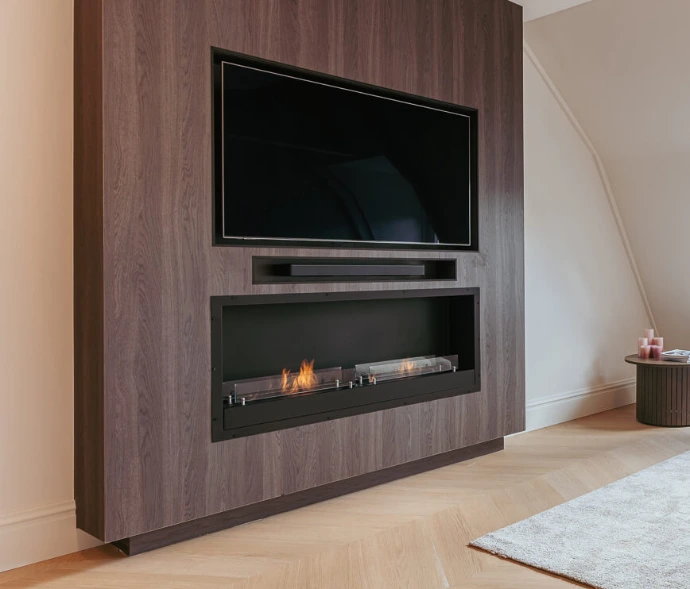
Why choose a bioethanol fireplace?
A fireplace that burns on bioethanol is more sustainable and cleaner than a fireplace on wood, oil or gas. A bio-ethanol fireplace that complies with the European Standard 16647:2015 is the safest way to use an open fire.